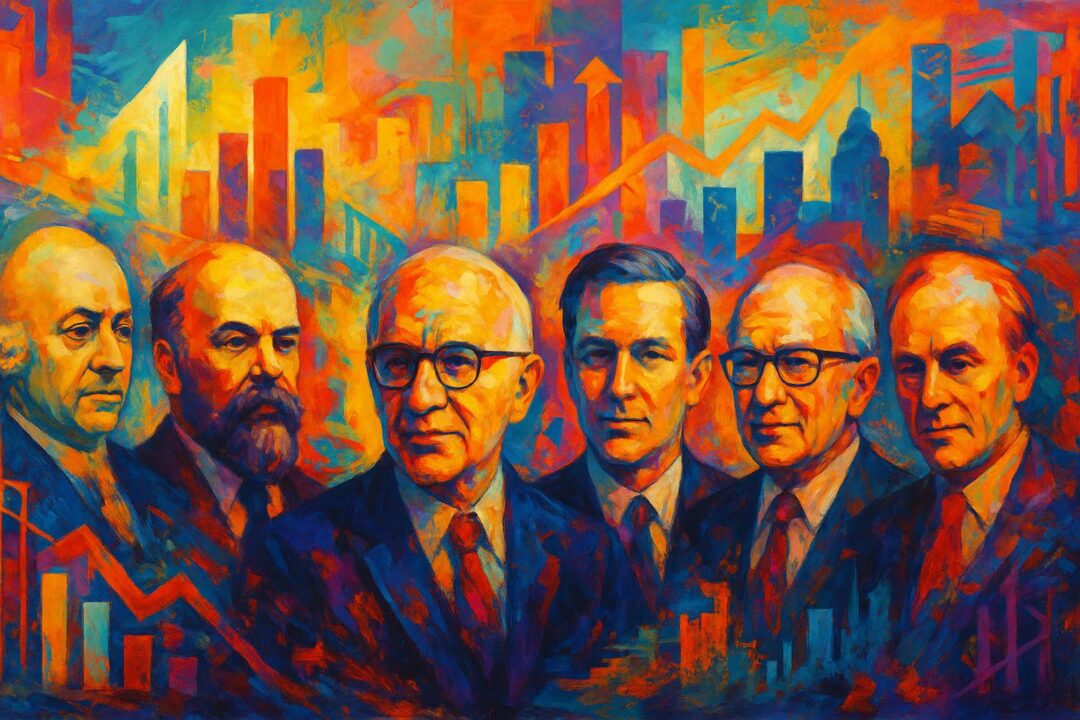
In the 1940s, the U.S. marshaled the brightest minds, the most advanced labs, and billions of wartime dollars to build a bomb unlike anything the world had ever seen. It was called the Manhattan Project. Today, we are witnessing something just as ambitious — but instead of uranium and plutonium, the raw materials are silicon, electricity, and data. Instead of generals in bunkers, the decisions are being made by corporate boards in Redmond, Mountain View, Seattle, and Menlo Park. The project is the race to build Artificial General Intelligence (AGI) — and its costs are staggering.
The Manhattan Project as a Benchmark
The Manhattan Project cost $1.9 billion in 1940s dollars, equivalent to ~$20 billion in 1990s terms. For a nation at war, it was a vast sum — but still only about 0.2–0.8% of U.S. GDP over the project’s life. It was a finite program with a clear deliverable: a working bomb before the Axis powers could get one.
Fast forward eighty years. In 2025 alone, Microsoft, Amazon, Alphabet, and Meta are set to spend more than $300 billion on AI datacenters, chips, and infrastructure. That’s more than 10–15 times the Manhattan Project in inflation-adjusted dollars — and critically, it’s every single year. As a share of GDP, the AI build-out is already larger than the bomb project ever was.
But here’s the twist: the “deliverable” this time is not a bomb. It’s something much less tangible and much more speculative — AGI itself.
AGI: a Moving Target
What exactly is Artificial General Intelligence? Ask ten AI researchers and you may get ten different answers.
- Some define AGI as an AI system that can perform any intellectual task a human can.
- Others emphasize adaptability: the ability to transfer knowledge across domains without retraining.
- Still others stress self-improvement: the capacity of a system to recursively enhance its own intelligence.
There is no universally accepted definition. In fact, some argue the concept is so fuzzy that it borders on unscientific.
And more importantly: no one knows if AGI is even possible. It may require breakthroughs beyond today’s machine learning paradigm. It may be forever out of reach. Or, if it does arrive, it may look very different from the science-fiction visions that inspire so much investment.
This makes the AI race profoundly different from the Manhattan Project. The bomb was a terrifying engineering challenge, but physicists knew it was possible — the physics was sound. With AGI, there is no such guarantee. The world is mobilizing trillions of dollars in pursuit of something that may remain an illusion.
Energy: the New Uranium
During World War II, the Manhattan Project consumed enormous amounts of specialized resources: uranium, graphite, heavy water, and the electricity to enrich fissile material.
Today, the new limiting factor is electricity itself.
Datacenters already use 4–5% of U.S. electricity, and projections suggest that by 2030 they could draw double that. The International Energy Agency estimates that globally, datacenter power use could hit ~945 terawatt-hours a year — more than the entire country of Japan consumes.
To put that into perspective:
- A single 100-megawatt AI datacenter uses as much electricity annually as 80,000 U.S. homes.
- A 1-gigawatt datacenter campus (ten times larger, now being planned) consumes more than some entire U.S. states.
Electricity, not algorithms, may prove the bottleneck.
Who’s Paying for This?
Unlike the Manhattan Project, which was government-funded, the AI race is being financed in a hybrid way:
- Private capital: Microsoft, Amazon, Google, and Meta are pouring in hundreds of billions each year.
- Suppliers: NVIDIA and TSMC are the early profit winners, selling chips with margins north of 70%.
- Public: Taxpayers subsidize chip plants, while utility ratepayers absorb the costs of new generation and transmission.
In other words: the costs are socialized, while the short-term profits are concentrated.
The NVIDIA Feedback Loop
This dynamic has created a financial flywheel that loops through both industry and capital markets:
- Hyperscalers announce bigger AI spending.
- NVIDIA sells more GPUs, posting record profits.
- NVIDIA’s stock surges, pulling up the Nasdaq.
- Investors pour money into tech ETFs, lifting all of Big Tech.
- Hyperscalers enjoy higher market caps and cheaper financing.
- They buy more GPUs. The cycle repeats.
At points in 2024, NVIDIA alone accounted for 30–40% of Nasdaq 100’s total gains. That’s not just a corporate success — it’s a systemic financial phenomenon.
The Global Race and Duplication Costs
Geopolitics makes the costs even higher. The U.S. and China are racing to lead in AI. Export controls prevent advanced U.S. chips from being sold to China, forcing both sides to build parallel supply chains. That duplication means higher costs and less efficiency — the economic equivalent of an arms race.
Can the World Afford It?
Technically, yes. The global economy is over $100 trillion annually. AI investment, while massive, is still a fraction of that.
But the real issue is return on investment.
- If AI boosts global GDP by $2–4 trillion annually (as some forecasts suggest), then the massive capital outlay will look like a bargain.
- If AI fails to deliver — or if AGI proves impossible — then the trillions spent will look like an overbuilt dream. Investors, utilities, and governments will be left with sunk costs and stranded assets.
That uncertainty makes the AI race both thrilling and perilous.
Lessons from History
The Manhattan Project had a clear end: build a bomb before the enemy does. The AI project does not. There is no definitive endpoint, no universally agreed success condition, and no guarantee of feasibility.
Both projects, however, share one striking feature: they compress decades of effort into a few short years, powered by vast mobilization of resources.
- In the 1940s, the bottleneck was uranium.
- Today, the bottleneck is electricity, chips, and — perhaps — the limits of human imagination.
Conclusion: The Second Manhattan Project
Oppenheimer’s project created a new world order through nuclear weapons. Today’s AI race is creating a new world order in technology, energy, and finance.
The difference is stark: the bomb was inevitable once the physics was understood. AGI may not be inevitable at all. It may be achievable, or it may forever remain out of reach. Yet trillions are being spent in pursuit of it, reshaping economies, energy grids, and markets along the way.
We are living through an industrial mobilization on the scale of the Manhattan Project — but one chasing a moving target that might not even exist.
That uncertainty is what makes this race not just costly, but historic.
Discover more from Brin Wilson...
Subscribe to get the latest posts sent to your email.